
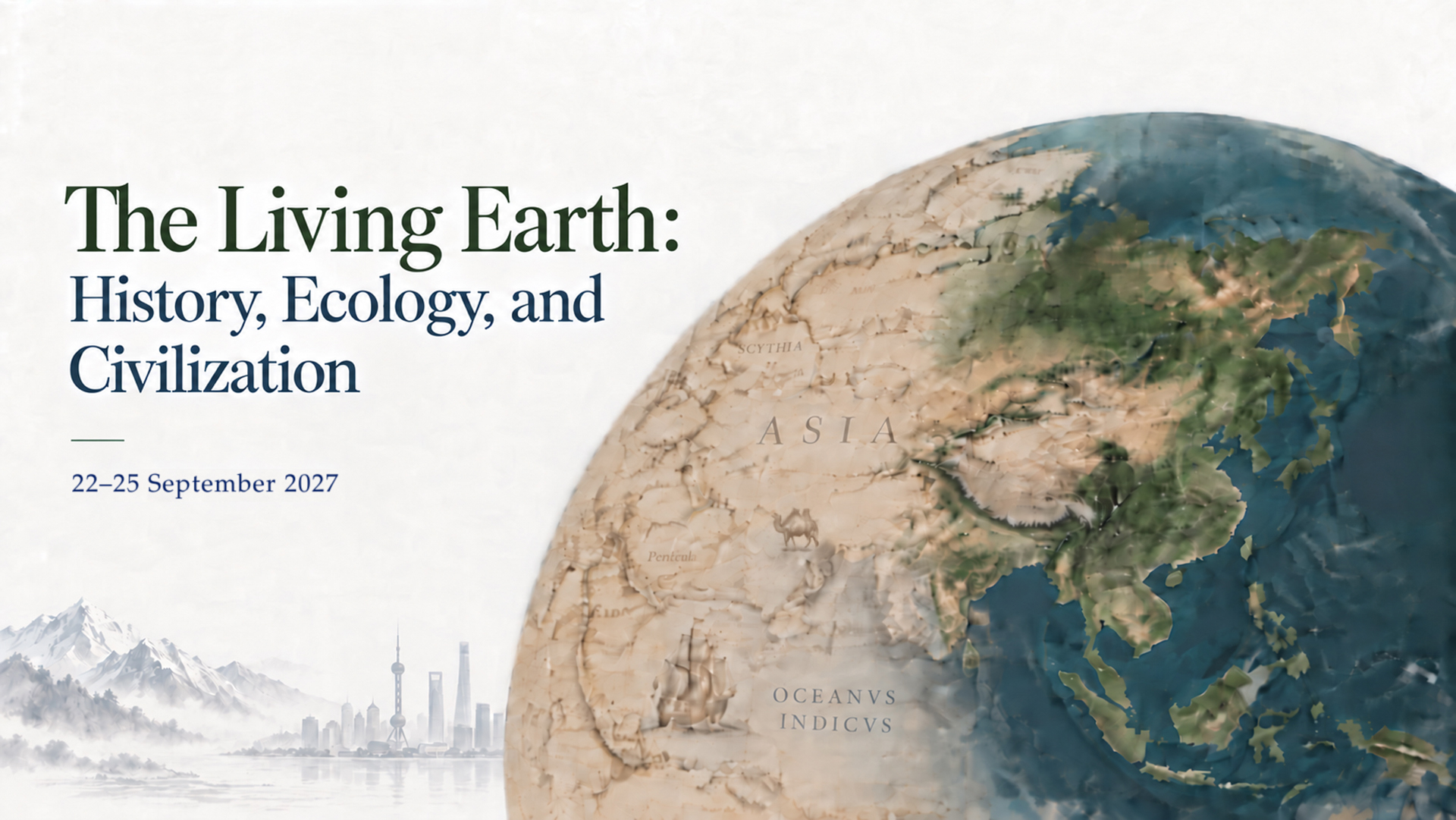
CFP: 2nd Biennial Asian Association for Environmental History (AAEH) Conference
会议征稿:第二届亚洲环境史学会双年会
The Living Earth: History, Ecology, and Civilizations
生生不息:历史、生态与文明
Beijing, China, Sept. 22-25, 2027
The Asian Association for Environmental History (AAEH) invites proposals for panel sessions, individual papers, posters, and roundtables for its upcoming biennial conference. The conference theme, “The Living Earth: History, Ecology, and Civilizations,” aims to highlight the interactive relationship between nature and culture, trying to put human history back into the much broader and deeper planetary history.
The Conference will be held in Beijing, China, from 22 to 25 September 2027. It will be sponsored by the AAEH and Peking University.
18:00-20:00 Sept. 22 Reception
8:00-17:00 Sept. 23 Sessions all day, lunchtime keynote 1, and dinnertime keynote 2
8:00-17:00 Sept. 24 Field trips
8:00-17:00 Sept. 25 Sessions all day and lunchtime keynote 3
18:00-20:00 Sept. 25 Farewell banquet
The deadline for submissions is 31 December 2026, 23:59 CST (UTC + 8).
Notifications will be sent out in February 2027.
Please submit your proposals here
The conference theme:
Our planet earth is endlessly creative and fertile. Many civilizations have grown out of their natural environments. For thousands of years the vast Asian lands and waters have constituted the most populated continent on earth and have nurtured the earliest agriculture and civilizations. The history of this continent has showcased the two-sided relationship between nature and culture. While humans have changed the natural environment dramatically, nature, both inorganic forces and forms of life including plants, animals, and microbes, have supported, shaped, and limited the evolution of human culture.
Now that approximately 65% of the Asian people dwell in cities, we tend to forget our complex and ancient connections with the natural environment and to believe that humans alone have created history and now dominate the planet Earth. But environmental historians remind us that the earth has always been an independent and spontaneous force interacting with culture. As Donald Worster wrote almost four decades ago: “Increasingly, as human will makes its imprint on the forest,... it may seem that there is no practical difference between ‘nature’ and ‘artifact.’ The distinction, nonetheless, is worth keeping, for it reminds us that there are different forces at work in the world and not all of them emanate from humans; some remain spontaneous and self-generating.”
This is not to say that we should adopt a reductionist approach. Instead, as more and more scholars in humanities and social sciences recognize the “agency” of other species, environmental historians also try to challenge the triumphant, cultural determinism of much of history.
For this conference we invite proposals dealing with the most ancient to most modern history of the interaction of nature and culture, not only in Asia but all over the world and from all perspectives. But especially we invite proposals tackling these issues:
1. The agricultural, farming, and grazing pasts of Asian civilizations
2. Hydraulic society and other theses about the making of power
3. Capitalism, colonialism, modernity, and ecological transformations
4. Population, fertility, and health
5. The environmental management state
6. Oceans and environmental history
7. Cities and their environments
8. Local knowledge and ecological wisdom
9. Environmental history approaches and methodologies
Presentation formats:
This conference is for in-person attendance only. Hybrid or online participation will not be accepted.
Each applicant can only organize one panel or round table and participate no more than two panels as chair, commentator, panelist, or round table discussant.
We invite individual paper proposals, but prefer the submission of complete panel sessions. Each session will be limited to 90 minutes.
1. Panel sessions:
Sessions will consist of 3 papers of 15 minutes each plus a commentator/discussant, or 4 papers of 12 minutes each plus a commentator/discussant. Session proposals should include a session title and session abstract of 250 words; a list of contributors and a chairperson/organizer; and individual paper titles and abstracts of around 250 words each. All sessions should reserve enough time for audience discussion.
[Information regarding panel proposals is to be submitted by the panel organizers]
2. Individual Papers:
Proposed papers can be co-authored or single-authored. In case of acceptance, the final program will consist of sessions organized into three to four papers. All paper proposals should consist of the name(s) of the author(s), the presentation title and an abstract of 250 words. The authors of accepted papers will be notified by late spring 2027 whether they should be allotted 12 or 15 minutes per paper, depending on the number of papers in the respective session.
3. Graduate students posters
Poster proposals should include the name(s) of the author(s), the poster title and an abstract of 250 words. Poster sessions will be on-site only. There will be a designated display area, and a general session in which all poster authors present their research, allowing five minutes per poster.
4. Roundtables by Researchers
A 90-minute roundtable, consisting of panels ranging from 3–6 researchers and a chair who speak to a common question or theme. Successful roundtables involve interaction between the panellists, an active chair who shapes the conversation, and time for the audience to interact with the panel. Roundtable proposals consist of the title, an abstract of 300 words and list the names of the chair and discussants.
Roundtables are welcome to examine a wide range of topics, such as the future of the field, the collaboration with scientists or activists, the role of environmental history research in relation to present and ongoing environmental crises, or other unconventional contents.
ABOUT AAEH
The Asian Association for Environmental History (AAEH) was established on 1 July 2023. Covering all of Asia and Oceania, this society builds on the work of the Association for East Asian Environmental History (AEAEH) during its 14 years of activity.
This is an official website. We proposed a new mission statement and bylaws, which were approved by the Association’s General Meeting in 2025.
Mission Statement
The Asian Association for Environmental History is a dynamic organisation dedicated to conducting and furthering research on Asian environmental issues through a historical lens and on global environmental issues through perspectives from and on Asia. Our membership is both interdisciplinary and international, reflecting the rich diversity and interconnectedness of Asian and related global environments necessary to investigate the deep time of human/natural history.
The objectives of our Association are:
– To promote scholarship that explores the intricate relationships between humans and the natural world, as well as interactions and intra-actions between humans and non-humans throughout history;
– To communicate with researchers from other fields, educators, and the public in learning about environmental issues from a historical perspective;
– To foster opportunities for planetary, regional, local, and comparative studies across a wide temporal spectrum within Asia and Asian diasporas.
For more information, please click here: https://www.iceds.net/aaeh/